Why I Collect Talers
A Taler first catches your attention as an object. It has weight and presence. Its broad silver surface may carry a commanding portrait, a complex coat of arms, a city view, or a design so finely engraved that you want to examine it under magnification. What keeps me collecting, however, is what happens after that first impression. The closer I look, the more there is to discover.
I collect primarily within the Habsburg world. It is a field large enough to sustain a lifetime of curiosity, yet connected enough that each new coin can deepen my understanding of the others. Through the collection, I can follow rulers and territories, artistic choices and political claims, and the long journey of individual coins from a historic mint to the present day.
History in the details
A Taler is a historical document made of silver. Its portrait and titles tell us how a ruler wished to be seen. The shields on its reverse can reveal a web of inherited lands and dynastic relationships. A mint name places it in a particular city, while a date can place it amid a succession crisis, a war, or a period of prosperity. Those details invite questions that a short catalogue description cannot fully answer.
The Habsburg story is especially rich because the dynasty ruled across many distinct lands. Austria, Tyrol, Bohemia, Hungary, and Transylvania did not share a single, unchanging identity. Their coins offer different ways of seeing the same broad political world. When I put specimens from these territories alongside one another, the collection becomes a way to explore both what connected them and what made each place distinctive.
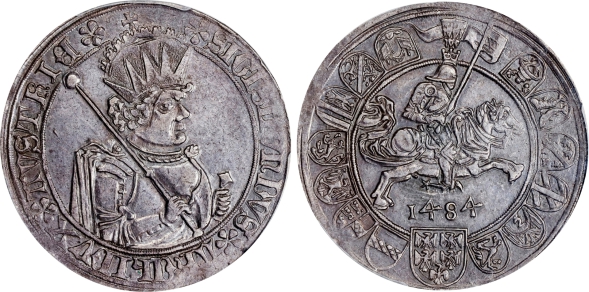
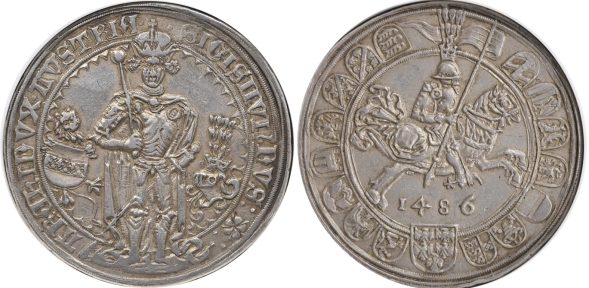
The early silver coinage of Archduke Sigismund particularly appeals to me. His half Guldiner of 1484 and Guldiner of 1486 take the story back toward the beginnings of the large silver coins that preceded the Taler. The 1484 piece shows an armored, crowned bust and a mounted knight. These are objects through which I can study an important transition in coinage, rather than merely read about it.
Art made to last
The large format of a Taler gave engravers an unusually generous canvas. Some portraits feel formal and distant; others convey a striking sense of personality. Eagles, crowns, heraldic shields, religious figures, and elaborate lettering can turn the reverse into a dense composition. The craftsmanship is often impressive even before I understand every symbol.
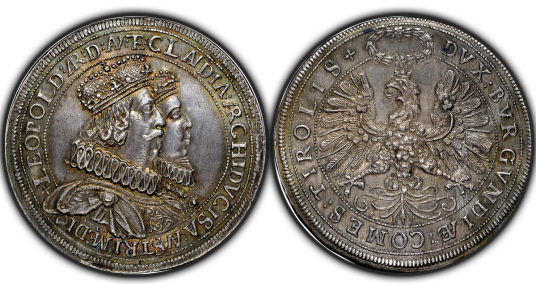
A coin can also preserve a specific occasion. The 1626 Double Taler commemorating the marriage of Archduke Leopold V and Claudia de’ Medici is a good example. Its two portraits make a dynastic event immediate and human. I value it for its design, but also for the way an event nearly four centuries old remains visible in a single piece of silver.
Why the individual specimen matters
A catalogue number identifies a type; it does not capture the character of a particular coin. Talers of the same issue may differ in centering, strike, preservation, toning, and the completeness of their legends. One may show the portrait at its best, while another has exceptional surfaces or a more balanced overall appearance. Part of the pleasure of collecting lies in learning to see those differences.
I favor coins that combine historical interest with exceptional visual quality. Strong detail and original surfaces help me see more of what the engraver intended. Mint brilliance and natural toning can add another dimension, but neither should distract from the coin itself. A numerical grade is useful information; my decision ultimately rests on the specimen in front of me.
That approach sometimes means passing on an available example and waiting. It also means that a coin outside a rigid list can be worth pursuing when its story or quality is compelling. I would rather build a collection of pieces that reward close attention than fill every possible gap for the sake of completeness.
The research and the search
Finding the right Taler is rarely a single step. I compare auction records, consult reference books, study photographs of other examples, and look at what can be learned about the survival of a particular issue. Population reports can be informative, though they are only one part of understanding scarcity. A coin’s provenance may add another layer by showing where it appeared in an earlier collection or sale.
Research can change my mind. An issue that initially looks familiar may prove difficult to find with an attractive strike or undisturbed surfaces. A seemingly obscure variety may lead to a larger historical question. The search rewards patience, and the knowledge gained along the way remains valuable even when I do not acquire the coin.
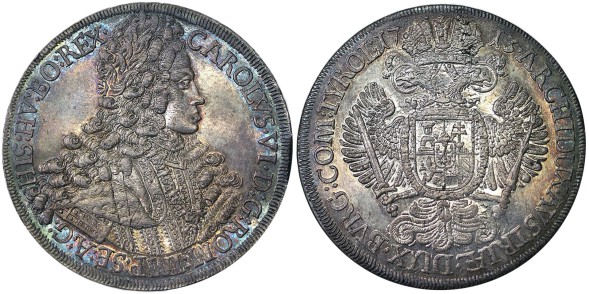
My 1713 Charles VI Taler from the Hall Mint illustrates that appeal in a different way. The portrait is exceptionally engaging, and the subtle range of colors across the silver gives the coin a presence that a catalogue reference cannot convey. It reminds me why I spend time looking at individual specimens: design and preservation meet in ways that are particular to each surviving coin.
A collection that continues to grow in meaning
There is no natural point at which this subject feels finished. A new coin may lead me to a ruler I had overlooked, a mint I want to understand better, or a design that changes how I view a familiar period. Talers connect numismatics with history, art, geography, economics, and the stories of the people who collected them before us.
That is why I created Taler Universe. I wanted a place to share the coins and the discoveries that come with them. The collection is personal, but the histories represented by these objects extend far beyond any one collector. I hope that a visitor who comes for the beauty of a coin will leave curious about the world that produced it.
I collect Talers because they reward both the eye and the mind. Each one is an object to appreciate, a specimen to study, and a point of entry into a much larger story. Together, they allow me to tell a part of European history through the coins that survived it.