Four centuries, one idea
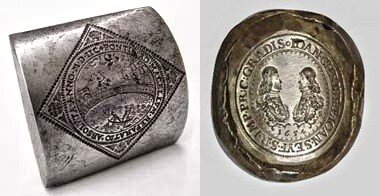
Every taler in this collection, however different they look, was made the same basic way: a die pressed hard into a blank disc of silver. What changed, again and again, was how much force a mint could bring to that one moment — and it took nearly four hundred years to get from a single hammer blow to a machine. A few of these photographs are from the Hall mint itself, where I got to see one of these machines still turning.
Hand hammering
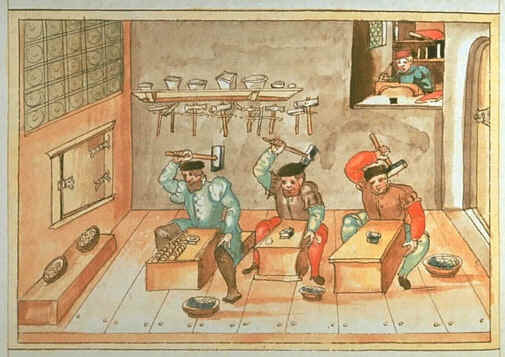
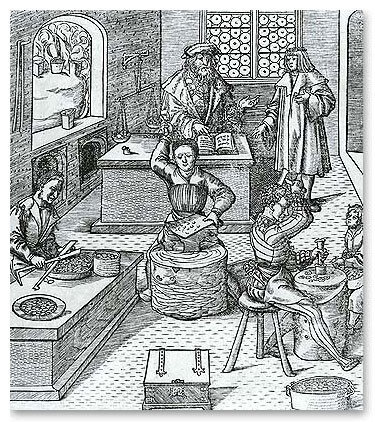
For most of the taler's early history, this is what a mint actually looked like: a workshop, not a factory. One die was spiked into a block or an anvil, a silver blank was set on top, the second die was held above it, and a coiner swung a hammer down — sometimes more than once, if the first blow didn't fully bring up the design. Blanks were cut by hand from hammered sheet and filed to weight, which is why hammered coins never quite have a perfectly round edge. That irregularity had a real cost: it made “clipping,” shaving slivers of silver off the rim, almost impossible to catch by eye.
The roller press
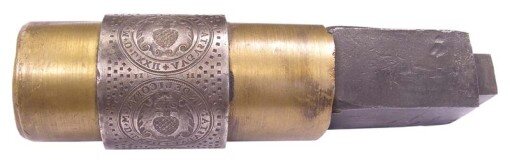
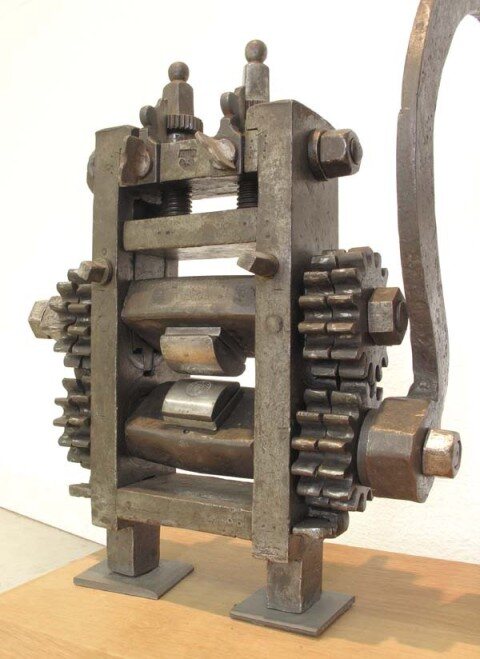
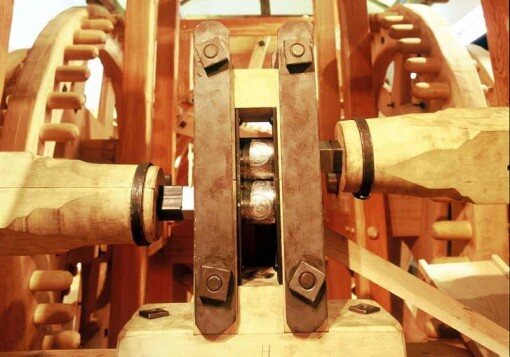
The fix came from the same mint that struck Sigismund's original guldiner. Around 1550, a wave of new machinery reached Europe's mints — usually credited to a German engineer named Marx Schwab — pairing rolling mills that pressed silver into strip of even thickness with engraved roller dies that stamped a continuous run of coins as the strip fed through. The technology was valuable enough to be worth stealing: in 1550 the French ambassador to Augsburg tried to acquire it covertly, and France's Henri II ended up importing the equipment outright. Hall adopted the roller press not long after.
Seeing it in person
This is the actual mechanism — two engraved cylinders, geared to turn together, with a strip of metal threaded between them. It's still functional at Hall, and watching it turn makes the whole idea click in a way no description quite manages: the strip goes in blank and comes out with a continuous run of coin designs stamped into it, ready to be cut apart.
The screw press
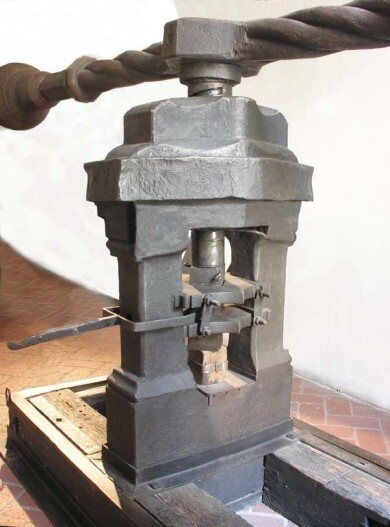
The screw press became the real standard, eventually displacing both hammer and roller across most of Europe. A weighted, spinning screw drove the die down with far more controlled force than a hammer blow, which meant stronger, more consistent strikes — and, just as importantly, it could stamp reeded or lettered edges onto a coin. That milled edge was the real answer to clipping: any tampering became visible at a glance. The screw press stayed the industry standard for roughly three hundred years.
Into the industrial age
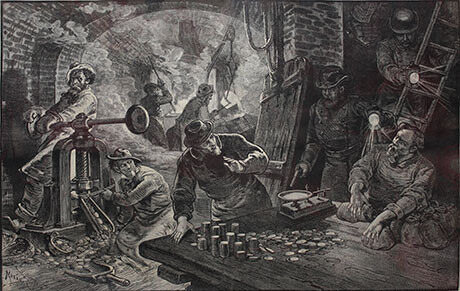
By the time this scene was engraved, minting had become genuinely industrial — stacks of finished coins piling up as fast as the press could cycle. Steam power took over from the screw press in the early nineteenth century, spread across Europe's mints largely through machinery built by the German engineer Dietrich Uhlhorn, and electric power replaced steam in turn by the early twentieth. The basic idea never changed from Sigismund's day — a die, pressed hard into a blank — only the force behind it did.
A few more views from the archive